A workshop session at Highlander
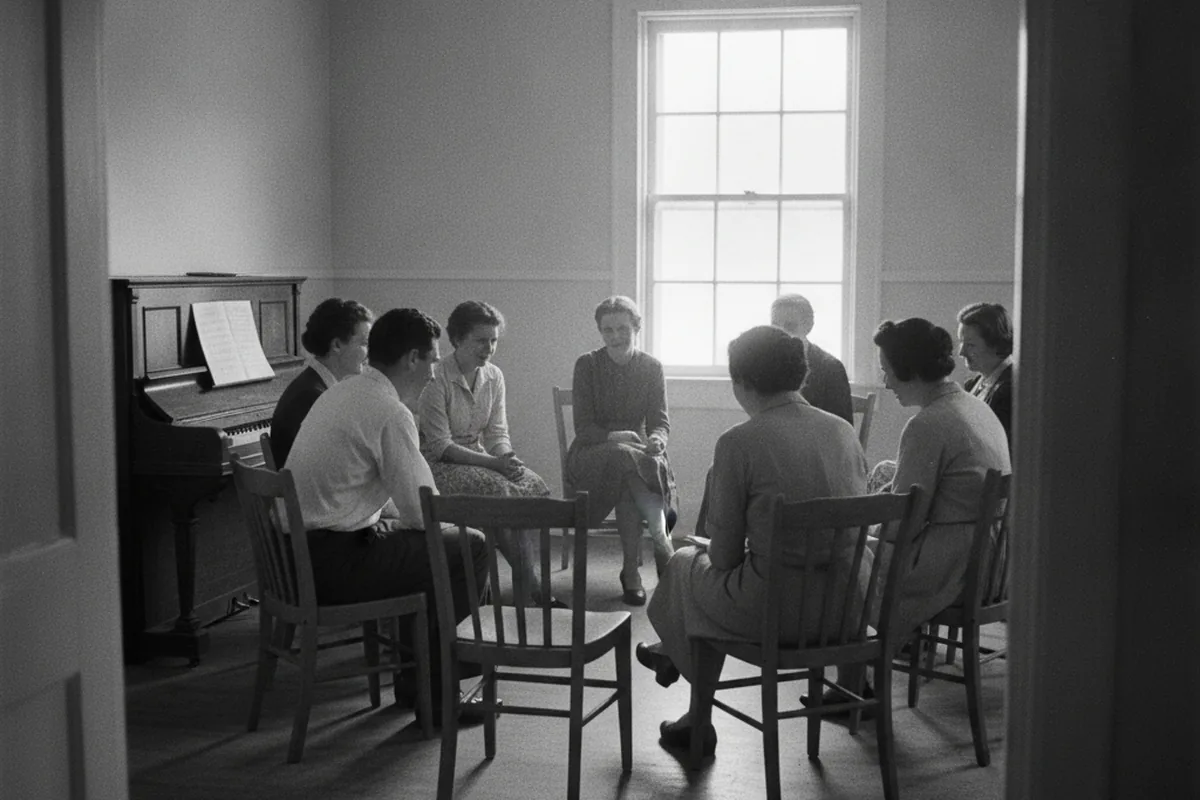
This record describes a photograph of a workshop session, the basic unit of Highlander's work. People sat together, talked through problems from home and left with plans.
What the record describes
This record belongs to the part of the Highlander collection devoted to workshops. The photograph it describes shows a workshop session in progress: participants gathered together in discussion, the format that defined the school.
We have not added names, a date or a photographer to this record. The details we hold are limited, and we would rather leave a field blank than guess. Many photographs of Highlander workshops were taken informally by staff or visitors and were catalogued years later, so gaps like these are common in the collection.
What the image shows is still worth looking at closely. Workshop photographs often reveal how the room was arranged, who sat next to whom and how many people took part. Those details are evidence of the method itself.
About the image on this page. The picture shown here is an illustrative reconstruction made for this site. It is not the archival photograph and should not be cited or reproduced as one. The catalogue details below describe the original.
How Highlander workshops worked
Highlander's workshops were residential. Participants came for days or weeks, slept and ate at the school and spent most of their time in discussion. For Black and white participants to live and work together this way was itself a challenge to segregation in Tennessee.
The method started from the participants' own experience. People arrived with problems from their communities: how to register voters, how to organise a union local, how to desegregate a school. Staff guided the conversation but did not hand down solutions. The group worked toward plans that people could carry home.
Septima Clark directed many of these workshops in the 1950s. The Citizenship Schools, which taught adults literacy so they could register to vote, grew out of this approach and spread widely across the South.
Workshops ended with action. The point was not a certificate but a plan, and many of the people who passed through Highlander became organisers in their own towns.
Pulled the files for “A workshop session at Highlander”. Folder names are inconsistent, I will map them before ingest.
Use the same crosswalk as last time. Dates go to ISO 8601, places to the gazetteer.
Once the record is clean we link it from the archive page and the journal piece.
Singing as part of the session
Music was woven into Highlander's workshops. Sessions often opened or closed with singing, and evenings brought more. Songs from churches, union halls and folk traditions were taught, adapted and shared among participants from very different places.
That practice helped turn existing hymns and spirituals into freedom songs. Workers in song at Highlander, among them Guy Carawan, helped carry those songs to student activists in the early 1960s. Members of movement groups, including singers active in the Albany campaign, also took part in Highlander workshops.
Seen this way, a photograph of a workshop session is also a record of the setting in which much of the movement's music was passed on. It belongs naturally alongside the materials described in Music of Social Change and our essay on the Albany Movement.
For the school's history, the 1959 raid and the court fight that followed, see the collection page.
Notes on this record
The catalogue fields below give what we can state with confidence. The identifier p2-se1-1 follows the original collection's numbering. Fields that are not in our notes are marked as not recorded, rather than filled in.
If you can identify people in this photograph, or know when and where it was taken, please write to us with your source. Identifications from people who attended Highlander workshops, or from their families, are especially valuable. We will add new details only when they can be supported.
Present-day note: collections of informal photographs often reach archives with almost no description. Inviting the community to help identify people is now a common practice, and it has recovered names that would otherwise be lost. The same approach could enrich this collection and others like it.
For the school's own history, visit the Highlander Research and Education Center.
Catalogue record
Workshop session at the Highlander Folk School
Residential workshop, group discussion
Not recorded in our notes
Not recorded in our notes
The Highlander Folk School: A Photographic History
p2-se1-1
Illustrative reconstruction, not the archival photograph