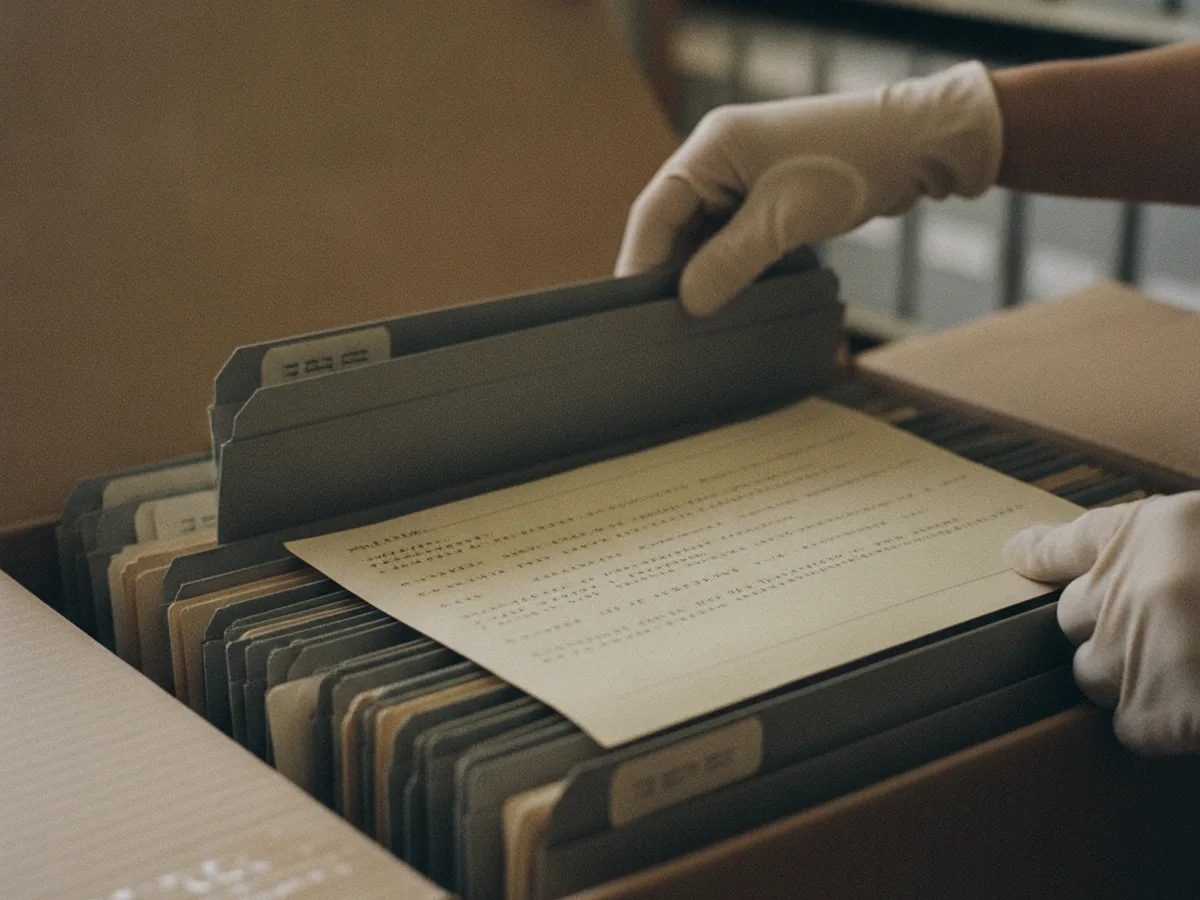
A finding aid is the map an archive draws of its own holdings. It tells a researcher what a collection contains, how it is arranged, who created it and where to look first. For most of the twentieth century that map was a typed document in a binder in the reading room. Today the same description is expected to be structured, searchable and shared across institutions.
The path from one to the other runs through two names that every archivist knows: EAD, the encoding standard, and ArchivesSpace, the most widely adopted open source system for managing archival description in the United States. This piece explains how they fit together and what a migration actually involves.
What a finding aid does
Archives describe material in aggregate. A library catalogs a book. An archive describes a collection of letters, photographs and records that came from one person or organization, often hundreds of boxes deep. Item-level cataloging is rarely possible, so the finding aid works in layers.
- Collection overview. Title, dates, extent, creator and a short abstract.
- Context. A biographical or historical note, plus the custodial history of how the material reached the archive.
- Scope and arrangement. What is in the collection and how it is organized into series and subseries.
- Access and use. Restrictions, conditions on reproduction and preferred citation.
- Container list. The box and folder inventory that leads a researcher to the physical item.
That layered shape, moving from general to specific, is the reason finding aids translate well into a hierarchical data format.
From paper to EAD
Encoded Archival Description began in the 1990s as an effort to put finding aids online in a consistent structure. Version 1.0 was released in 1998. EAD 2002 followed and became the long-running standard. The current version, EAD3, was released in 2015. The Society of American Archivists maintains it together with the Library of Congress, which hosts the official schema.
EAD is an XML vocabulary. It has elements for the overview, the notes and, most importantly, the nested components of a collection. A series contains files, files contain items, and each level can carry its own dates, extent and notes. That nesting mirrors the way archivists already think.
EAD defines structure, not content. The rules for what to write in each field come from a separate content standard. In the United States that is DACS, Describing Archives: A Content Standard, also maintained by SAA. Keeping the two apart is useful. You can follow DACS in a word processor, a database or an XML file and still describe the collection the same way.
In practice, many repositories first produced EAD by hand or with templates, converting typed finding aids one at a time. The results were uneven. Some files were valid but thin. Others mixed presentation with structure. That history still shows up when those files are migrated today.
Pulled the files for “Finding aids, from typed lists to ArchivesSpace”. Folder names are inconsistent, I will map them before ingest.
Use the same crosswalk as last time. Dates go to ISO 8601, places to the gazetteer.
Once the record is clean we link it from the archive page and the journal piece.
ArchivesSpace as the system of record
Hand-encoded XML is hard to maintain. Change a box number and you edit a file. Change a subject term across fifty collections and you edit fifty files. Collection management systems solve this by storing description in a database and generating EAD as an export.
ArchivesSpace emerged in the early 2010s from the merger of two earlier tools, the Archivists' Toolkit and Archon. It is open source and supported by a membership program. It manages accessions, resources and their component hierarchies, agents, subjects, locations and digital objects. It exports EAD and MARCXML, and it can expose records through OAI-PMH.
| Era | Form of description | Main limitation |
|---|---|---|
| Typed finding aids | Paper or word-processed documents | Not searchable across collections or institutions |
| Hand-encoded EAD | One XML file per collection | Hard to edit in bulk, uneven quality |
| Collection management system | Database records with EAD export | Migration and cleanup effort up front |
The important shift is conceptual. The EAD file stops being the master copy. It becomes one output among several, generated from a database that is easier to keep consistent.
Migration in practice
Moving legacy finding aids into ArchivesSpace is mostly a data cleanup project. The importer accepts EAD, but it is strict about structure, and old files rarely follow one pattern. Plan for these steps:
- Inventory. Count your finding aids and note their formats: EAD versions, word documents, spreadsheets, paper only.
- Profile. Run a few files through validation and look for repeated problems, such as dates in free text, container data in the wrong element or missing unique identifiers.
- Normalize. Fix those patterns in batches with scripts or XSLT before import. Cleaning once is cheaper than fixing records one by one afterward.
- Test import. Load a sample into a test instance and compare it with the source. Check hierarchy, dates and containers.
- Load and review. Import in batches, keep logs and assign staff to spot-check.
Agents and subjects deserve special attention. Legacy files often spell the same person three ways. Reconcile names against an authority file during migration and you gain consistent access points across every collection. Our guide to metadata quality metrics suggests simple ways to measure that improvement.
Budget time for people as well as data. Someone must decide how to treat records that do not fit, answer questions from colleagues and keep a log of every transformation. That log matters later. When a researcher asks why a date looks odd, you can trace it back to the source file and the script that changed it.

Discoverability beyond your own site
Structured description pays off when it travels. A finding aid locked inside one system helps only the researchers who already know to look there. Exported EAD can feed state and regional aggregators. MARC records can bring collection-level description into library catalogs. OAI-PMH lets harvesters pick up records automatically, a topic covered in our look at OAI-PMH today. Public interfaces should also be indexable by search engines, since many researchers start there.
This goal is not new. In the 2000s the Music of Social Change project, part of the MetaScholar Initiative at Emory, addressed the same problem. Archives, libraries and museums held related material about music and the African American freedom struggle, described in incompatible formats. The project mapped those records to a common schema and served them through one searchable system. EAD and modern collection management systems pursue the same aim with stronger structure.
Where to start
If your finding aids are still mostly documents, do not try to encode everything at once. Begin with collection-level records for every collection, even if container lists come later. A short, accurate overview for all holdings is more useful than a perfect inventory for a few.
Then pick a content standard and stick to it. Agree on how dates, extents and names are written. Choose a system that can export EAD, and treat it as the source of truth from that point on. Finding aids will keep changing. A clean, structured base makes each change cheaper than the last.