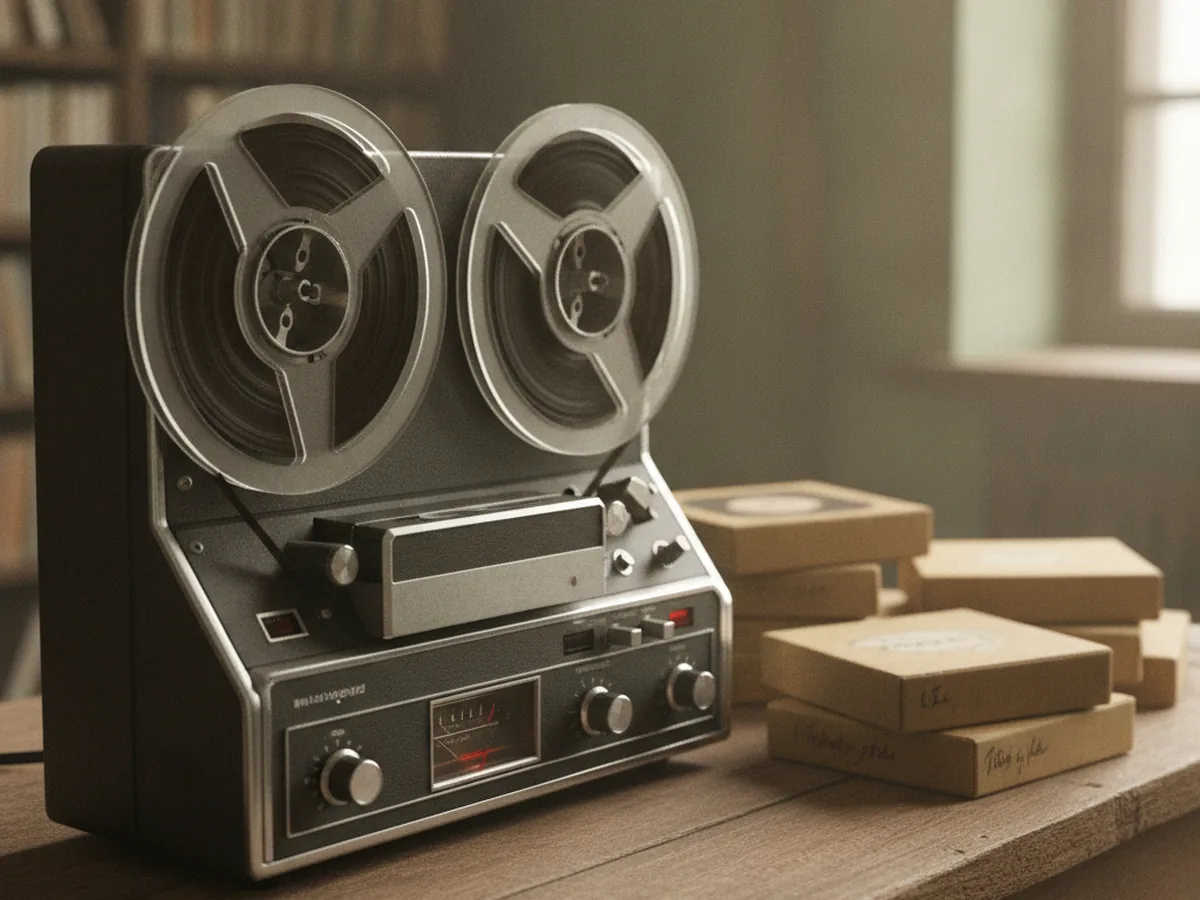
Many archives hold boxes of quarter-inch reels and audio cassettes: field recordings, oral histories, rehearsal tapes, radio programs, meetings. Some of them are the only copy of a voice or a song. Magnetic tape degrades, and the machines that play it are getting harder to find and repair. That combination makes audio one of the most urgent digitization jobs in a typical collection.
This guide covers the four parts of the work: playback, capture specifications, metadata and rights. It is written for archives that will do some of the work in house and send the rest to a vendor.
Why audio is urgent
Paper can wait decades in a stable room. Tape usually cannot. Several problems are common in collections from the 1960s through the 1990s:
- Binder breakdown. Some tape stocks absorb moisture and become sticky, a condition known as sticky shed. They squeal, shed oxide and can clog a playback head within seconds.
- Physical damage. Brittle splices, stretched or creased tape, and cassette shells with failed pressure pads.
- Machine obsolescence. Working professional decks, spare parts and technicians who can align them are scarce.
- Unknown formats. Track layout and speed are often unlabeled, so the content is invisible until someone plays it correctly.
Every playback carries some risk. The goal is to play each tape once, well, and capture everything in that pass.
Playback comes first
Capture quality is limited by playback quality. A high sample rate cannot rescue a misaligned head. Before transferring anything, a technician should inspect and, where needed, treat each item.
- Inspect. Check for mold, odor, sticky surfaces, broken leaders and old splices. Separate anything suspect.
- Identify the format. Determine tape width, track configuration (full, half or quarter track, mono or stereo) and speed. Open-reel speeds such as 3¾, 7½ and 15 inches per second are common. Standard cassettes run at 1⅞ inches per second.
- Treat if needed. Sticky tapes are sometimes treated by controlled low-temperature baking before playback. This is specialist work and should be done by someone experienced with it.
- Align the machine. Clean the tape path and align azimuth to the tape. Use the correct equalization standard for the recording.
- Play once, capture all. Record the full tape, including silence, false starts and talk between takes. Editing can happen later on a copy.
If you do not have a maintained deck and someone trained to run it, send the tapes to a vendor. A failed in-house attempt on a fragile reel can destroy the content.
Capture specifications
Community guidelines, especially IASA TC-04 from the International Association of Sound and Audiovisual Archives and the audio guidance of the Federal Agencies Digital Guidelines Initiative, have converged on a clear target for analog sources.
| Parameter | Preservation master | Access copy |
|---|---|---|
| File format | Broadcast WAV (BWF) | MP3 or AAC |
| Sample rate | 96 kHz | 44.1 or 48 kHz |
| Bit depth | 24-bit | Set by codec |
| Channels | As recorded, all tracks captured | Mono or stereo as appropriate |
| Processing | None, no noise reduction or normalization | Light cleanup allowed |
| Integrity | Checksum at creation | Regenerate from master |
Broadcast WAV, defined by the European Broadcasting Union, is a WAV file with an extra chunk for embedded metadata such as a description, originator and coding history. That chunk travels with the file and survives renaming and copying. Free tools such as BWF MetaEdit, developed for FADGI, make it easy to write and check.
Keep the master untouched. Any restoration, trimming or noise reduction belongs on a derivative. Record a checksum the moment the master is written, then manage it like any other preservation file. The BagIt and fixity guide explains that step.
Metadata that makes audio usable
An audio file without description is close to useless. Nobody can skim a forty-minute recording the way they skim a letter. Good audio metadata has three layers.
- Descriptive. Title, performers or speakers, date and place of recording, subjects, and a summary or time-coded log of contents.
- Technical. Source format, tape speed, track configuration, playback deck, converter, sample rate, bit depth and any treatment such as baking.
- Preservation. Checksums, transfer date, operator and an event history, in the style described in our PREMIS explainer.
Write down everything on the box, the reel and any inserts before the tape goes near a machine. Photograph them. Those notes are often the only source for dates and names.
Shared description also matters. The MetaScholar Initiative, a digital library programme run from Emory's Woodruff Library in the 2000s, ran the Music of Social Change project with support from the Institute of Museum and Library Services. It brought together records about music and the African American freedom struggle from partners including the Center for the Study of Southern Culture, the Atlanta History Center, the Georgia Music Hall of Fame and the Highlander Research and Education Center, mapping them to Dublin Core so they could be searched in one place. Recordings that are well described can join that kind of shared discovery. Recordings that are not stay hidden even after they are digitized. The project's essay on Broadside magazine and topical songs shows how much context a single collection can carry.

Rights and permissions
Digitizing for preservation and publishing online are different decisions. Preservation copies are generally easier to justify. Public access needs a rights review, and audio collections often involve several layers of rights at once.
A music recording may involve rights in the composition, rights in the sound recording and the interests of the performers. In the United States, the Music Modernization Act of 2018 brought sound recordings made before 1972 under federal copyright law, which changed the analysis for many older collections. Oral histories raise a different question: whether the narrator signed a release, and what it allows. Some recordings also contain sensitive material about living people or communities, which deserves care regardless of copyright status.
A practical approach is to record a rights status for every item at the time of transfer, using a standard statement where possible, and to publish only what has been cleared. Streaming access, lower-quality excerpts or on-site listening can be reasonable middle steps.
Planning the project
Decide early how much work happens in house. A common split is to keep inspection, description and rights review inside the archive, and to send the actual transfers to a vendor with maintained machines and trained staff. Ask vendors for their capture specifications, their equipment list, and how they handle sticky or damaged tapes. Ask for a sample transfer before committing a full batch, and check the files yourself.
Start with a survey. Count items by format, note condition and identify the content you know is unique. Prioritize by risk and value together: a deteriorating tape with irreplaceable content goes first. Budget for description as well as transfer, since it usually takes longer than the capture itself. Then work in batches, check each batch, and keep the original carriers in cool, stable storage after transfer. Sometimes a better playback becomes possible later.